
In this edition of Climate Insurance Insights, the perspective is slightly broader. Rather than focusing on a single case study from one part of the climate insurance value chain, the analysis draws on nearly a decade of experience across the InsuResilience platform to examine three structural obstacles to expanding climate insurance in emerging markets. The recently published 2025 Impact Report, Closing the Climate Protection Gap, explores these themes in great depth, also drawing on 60 Decibels’ research into end-client experiences across five investees of the platform.
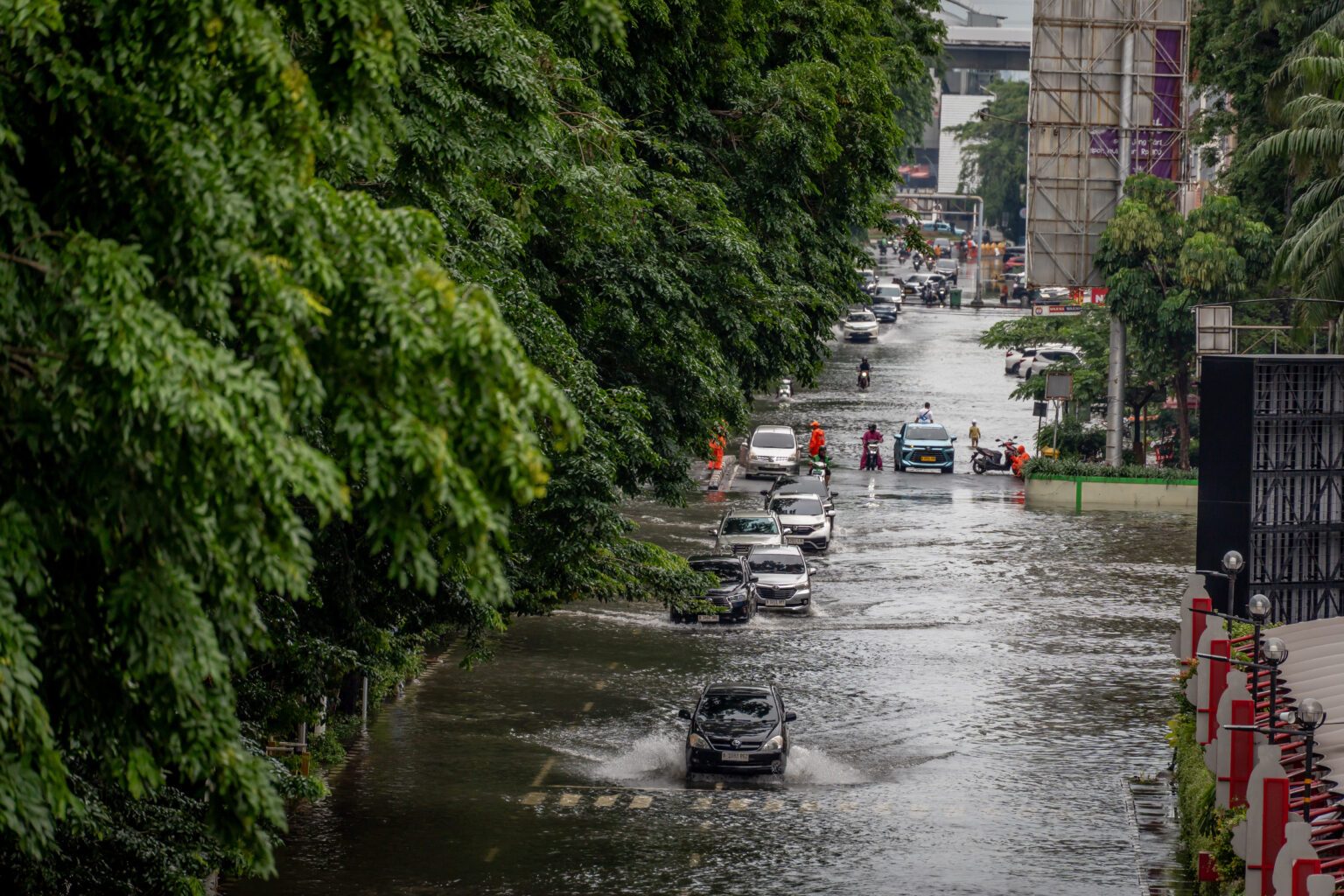
Climate change is accelerating. The frequency, intensity and unpredictability of weather-related shocks are rising, and the people least able to absorb the losses are the ones most exposed. In many of the emerging markets where households and micro, small and medium enterprises (MSMEs) depend on climate-sensitive livelihoods, the figures are stark:
- crop insurance penetration in sub-Saharan Africa sits at around 3%,
- and some 80–90% of climate and natural-catastrophe losses remain uninsured.
- The protection gap in emerging markets stands at roughly 35% in premium-equivalent terms because exposure is highest where financial protection is thinnest.[1][2]
It would be tempting to conclude that this gap persists because of weak demand. The evidence from nearly a decade of dedicated investment suggests otherwise. The InsuResilience platform, including both debt and equity funds, has deployed approximately USD369 million across 55 companies in Africa, Asia and Latin America, reaching some 80 million beneficiaries by the end of 2025. Established by KfW on behalf of Germany’s Federal Ministry for Economic Cooperation and Development (BMZ) and managed by BlueOrchard, the platform represents one of the largest investment strategies dedicated to closing the climate protection gap.
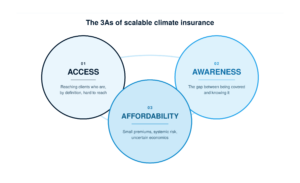
Its central lesson is uncomfortable but clarifying. Scaling climate insurance in underserved markets is not primarily a demand problem. It is a delivery problem, and that delivery problem resolves into three structural obstacles that each, individually, look insurmountable. We refer to them as the “3As”: access, awareness and affordability. Each determines whether insurance reaches clients, is understood and trusted, and provides meaningful value when a climate shock strikes.
What follows is an examination of why each obstacle appears so intractable, and why, on the evidence, none of them is.
Obstacle One: Access
Reaching clients who are, by definition, hard to reach
The first obstacle is simply getting a usable product into the hands of people who need it. In many target markets, climate insurance is operationally unreachable. Products may exist on paper, but not through any channel a smallholder farmer or a Kirana-shop owner can actually use. Small-ticket products are expensive to distribute and service through conventional channels, and the clients themselves are often first-time insurance users with no reference point for what insurance is or how to buy it.
The scale of the challenge is visible in the client research. Across 1,107 end-client interviews conducted by 60 Decibels in context of the Impact Report of the platform, 91% of respondents reported they had not previously had access to comparable insurance, and 84% could not easily identify an alternative. These are genuinely underserved populations: in the Cambodian survey of Forte’s rice-insurance clients, 95% were first-time insurance recipients, with a median age of 53, an average farm size of two hectares, and 48% earning less than USD3.30 per day.
Why does access look insurmountable? Because the economics of reaching such clients one policy at a time do not work. The cost of acquiring, onboarding and servicing a USD1 or USD10 premium through agents and branches dwarfs the premium itself. In addition, in many cases the operational complexities of paying out claims may present an even higher challenge than selling the product in the first place.
Why it is not insurmountable. The platform’s experience suggests that access can be expanded through different models, depending on customer context. For lower-income or first-time insurance users, embedded distribution can work particularly well because it introduces protection through an existing financial, agricultural or commercial relationship and, importantly, leverages established trust.
- FinAGG3 in India embeds flood, fire, earthquake and burglary cover directly into invoice-based working-capital loans for small retailers, reducing policy cost by up to five times relative to direct retail purchase.
- Pula3 in Africa reaches smallholder farmers through public input programmes such as Zambia’s Farmer Input Support Programme, where 811,000 Zambian clients alone represented around 20% of its base in 2025, bundling insurance with subsidised fertiliser.
- Igloo3 in Southeast Asia distributes through embedded partnerships at enormous scale, selling close to 800 million policies in 2025.
Based on the platform’s experience, the common denominator is unambiguous: access is strongest where insurance is introduced through existing customer journeys. For many lower-income and first-time users, this means building on relationships they already trust; for more insurance-aware customers, it can mean a smooth self-service journey. Thus, in our experience, distribution is the primary driver of scale. Technology compounds the effect by lowering distribution and servicing costs which can reduce the minimum commercially viable policy size and premium and thereby widen the addressable customer base. Naked’s digital model illustrates this route to access, while faster claims processing strengthens perceived value and continued use rather than access itself.
Obstacle Two: Awareness
The gap between being covered and knowing it
Solve access, and a second, subtler obstacle emerges immediately behind it. Clients may be technically insured yet entirely unaware of the fact they are. The embedding that makes access efficient can weaken or even sever the customer’s connection to the product. Embedded insurance can provide an initial endowment of cover, but the customer still needs to understand how to claim and later make a conscious decision that the product is worth retaining. In this sense, embedding can only postpone rather than eliminate the friction of customer education and value recognition.
The 60 Decibels survey process made this painfully evident. Of roughly 11,000 individuals initially contacted, only up to 35% were aware that they personally held the cover in question. The contrast across the portfolio is striking. In Pula’s distribution-led model, product awareness reached 94%. In FinAGG’s deeply embedded model, only 11% of contacted customers could fully recall the insurance without prompting; recall improved only when the vendor partner or the loan was mentioned.
Why does awareness look insurmountable? Because the more invisible the distribution, the weaker the client’s direct comprehension tends to be. And the stakes are high: a shop owner who received flood cover bundled with a loan will not automatically know how to contact the insurer or file a claim when a flood hits.
Why it is not insurmountable. The evidence shows awareness is both measurable and improvable, and that it matters enormously for whether the market deepens. Clients who understand their policies are more than twice as likely to renew: 66% renewal intent among those with good understanding, versus 28% among those without. Trust, meanwhile, is built through experience: 70% of clients who received a payout plan to renew, against 44% of those who did not.
Crucially, awareness is not inevitably weak in embedded models. Pula demonstrates that if the product logic is simple enough and the distribution setting makes the rules visible, understanding can be strong. Where gaps appear, they can be closed deliberately, for example, FinAGG responded to its findings by intensifying customer outreach, integrating insurance information into its app, introducing automated reminders, and using Technical Assistance grants to strengthen insurance literacy among both field staff and end clients. Forte[3] (a Cambodian general insurer) combines insurance, financial and agricultural literacy training with publicly available rainfall triggers and visible, SMS-based payouts. Awareness means clients must understand when and how to claim, trust that the product will work and recognise its value before they need it. It is therefore a communication and value-recognition layer that must be built as deliberately as the transaction layer.
Obstacle Three: Affordability
Small premiums, systemic risk, uncertain economics
(Source: InsuResilience Investment Fund and InsuResilience Investment Fund Private Equity II SCA SICAV-RAIF 2025 Impact Report: Closing the Climate Protection Gap Impact results and lessons from investing across the climate insurance value chain in emerging markets from 2015 to 2025)
The third obstacle is the most structurally stubborn. Target clients have low and irregular incomes. Climate risks are systemic, a single drought or cyclone can hit every policyholder at once, creating pricing and reinsurance challenges. Hazard and loss data are often weak, complicating pricing and trigger design. In addition, meaningful agricultural cover requires substantial payout capacity, which pushes premiums beyond what low-income farmers can pay. The result is a model that appears commercially unviable at the price point clients can bear.
Why does affordability look insurmountable? Because it seems to demand a permanent subsidy. Forte’s product still depends on subsidy support; its average payout covered only about a third of the USD100 sum insured, and 99% of recipients reported that insurance covered less than half their losses. In Vietnam, a rigorous study of Igloo’s rainfall insurance found that even substantial subsidies failed to convert stated willingness-to-pay into actual purchases as non-price barriers such as low trust proved decisive.
Why it is not, but with a caveat. The platform’s most important reframing is that affordability is not a function of price alone. It is a function of product design, expectations and performance. Across the sample of the 60 Decibels interviews, 82% of payout recipients reported that insurance covered less than half their losses, yet 58% still said the payout met or exceeded expectations, and 85% of payout recipients described the product as good value for money (against 52% of those without a payout). Perceived product value is inseparable from whether the product works when needed.
Timing is decisive. Among Pula customers, those who received payouts on time returned a Net Promoter Score of 61; those who experienced delays, −61. Climate insurance, properly understood, delivers recovery liquidity rather than full loss replacement, and even a modest payout arriving at the right moment can still be transformative. The resilience outcomes bear this out: 84% of payout recipients said insurance helped them recover financially, 71% said it helped them avoid additional debt, and 92% felt better prepared for future shocks.
Two levers make affordability achievable. First, structural cost reduction through scale and technology: Naked increased gross written premium by 99.6% between 2020 and 2025, cut its loss ratio from 74% to 66%, and reduced operating expenses from 103% to 43% of GWP, enabling lower pricing without sacrificing sustainability. Second, strategic, phased subsidy. The platform’s Grant Facility (EUR 21.5 million committed, across 72 Technical Assistance and 19 Premium Support projects in 2025) uses declining subsidies conditional on business growth, designed explicitly to build sustainable willingness to pay.
The caveat: in smallholder agriculture, affordability remains structurally linked to subsidy. Some low-income, highly exposed segments are likely to require ongoing public support. Premium Support should therefore be designed not only to crowd in direct policyholder demand where this is realistic, but also, in agricultural programmes, to demonstrate demand and value to public institutions that may sustain the subsidy after donor support ends. The task is to make the subsidy targeted, evidence-based and linked to measurable outcomes, including whether timely protection helps farmers maintain the next production cycle.[4]
Conclusion: Insurmountable only in isolation
The three obstacles appear insurmountable when confronted individually. Access without awareness creates nominal coverage with weak customer value. Awareness without affordability limits uptake. Affordability without reliable execution never earns trust or renewal. The 3As are tightly interlinked, and attacking any one in isolation fails.
What a decade of implementation demonstrates is that they can be surmounted together, through a value-chain approach that strengthens insurers, distributors, enabling financial intermediaries and technology providers simultaneously; through embedding insurance in trusted relationships; through deliberate investment in client understanding; and through strategic, phased subsidy. The platform’s trajectory from fewer than one million beneficiaries in 2015 to more than 80 million by the end of 2025 provides evidence of the platform’s ability to scale.
[1] Swiss Re Institute, “Adaptation and insurance: strategies to narrow the protection gap” (2026), reporting that 80–90% of catastrophe losses remain uninsured in many emerging markets. https://www.swissre.com/institute/research/sigma-research/sigma-2026-01-natcat-2025-wildfire-storm-risk/adaptation-insurance-narrow-protection-gap.html
[2] Global Center on Adaptation, “Inclusive Insurance for Smallholder Farmers in Africa” (4 November 2022), reporting that fewer than 3% of farmers in sub-Saharan Africa are protected. https://aaap.afdb.org/projects/inclusive-insurance-smallholder-farmers-africa
[3] A portfolio company of InsuResilience Investment Fund Private Equity II SCA SICAV-RAIF (“IIF II”). This fund has been closed for investments. Information for illustrative purposes only.
[4]BlueOrchard Grant Facility monitoring data and portfolio discussions concerning Premium Support, Pula and Forte, 2019–2025. Primary programme evidence; not independently published.
Important information
Marketing material for Professional Clients and Qualified Investors only.
The information in this publication was produced by BlueOrchard Finance Ltd (“BOF”), part of Schroders Capital which refers to those subsidiaries and affiliates of Schroders plc that together comprise the private markets investment division of Schroders.
This document includes references to a specific fund which has been closed for new investments. The information provided is for existing investors and/or illustrative purposes only.
Nothing in this publication shall be construed as constituting any offer to purchase any product, or a recommendation/solicitation or other inducement to buy or sell any financial instrument of any kind and shall not under any circumstances be construed as absolving any reader of this publication of his/her responsibility for making an independent evaluation of the risks and potential rewards of any financial transaction.
Forward-looking information is not a guarantee of any future performance and there is no assurance that any forecast or projection will be realised.
Past performance is not a guide to future performance and may not be repeated. The value of investments and the income from them may go down as well as up and investors may not get back the amounts originally invested. Exchange rate changes may cause the value of any overseas investments to rise or fall.
The information provided in this publication is intended for review and receipt only by those persons who are qualified (in accordance with applicable legal/regulatory definitions) in their respective place of residence and/or business to view it, and the information is not intended under any circumstances to be provided to any person who is not legally eligible to receive it. Any recipient of information from this publication who wishes to engage with BOF in furtherance of any transaction, or any relationship whatsoever must consult his/her own tax, legal and investment professionals to determine whether such a relationship and/or transaction is suitable.
BOF has outsourced the provision of IT services (operation of data centres, data storage, etc.) to Schroders group companies in Switzerland and abroad. A sub-delegation to third parties, including cloud-computing service providers, is possible. The regulatory bodies and the audit company took notice of the outsourcing, and the data protection and regulatory requirements are observed. For information on how BOF and the Schroders Group may process your personal data, please view the BOF Privacy Policy available at www.blueorchard.com/legal-documents/ and the Schroders’ Privacy Policy at https://www.schroders.com/en/global/individual/footer/privacy-statement/ or on request should you not have access to these webpages.
Issued by BlueOrchard Finance Ltd, Talstrasse 11, CH-8001 Zurich, a manager of collective investments authorised and supervised by the Swiss Financial Market Supervisory Authority FINMA, Laupenstrasse 27, CH-3003 Bern.
© 2026 BlueOrchard Finance Ltd. All rights reserved.