
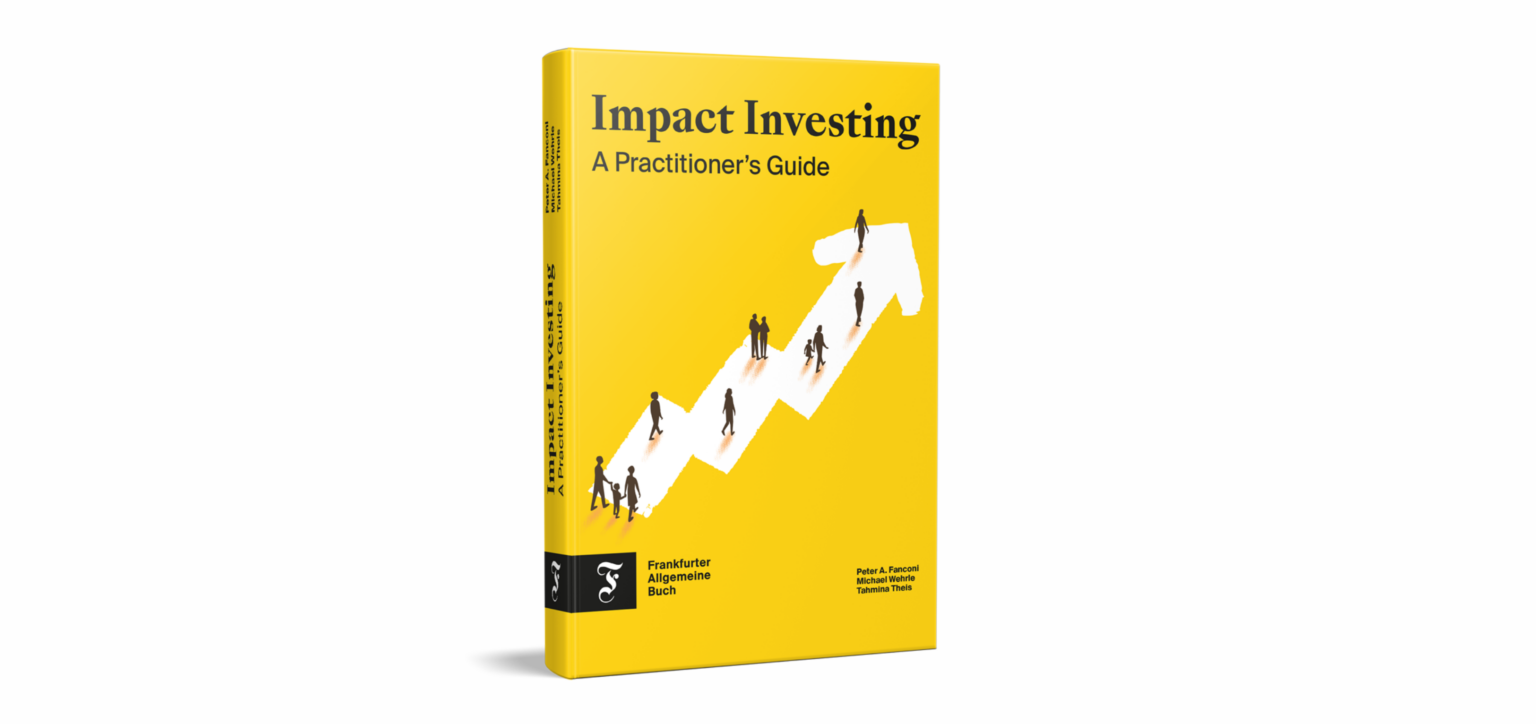
Impact Investing: A Practitioner’s Guide
This new publication takes readers beyond theory and shows how impact investing works in practice. It combines academic expertise with decades of investment experience.
The book offers practical guidance on identifying opportunities, assessing risk and return, constructing portfolios and measuring impact.
It covers private and public markets across developed and emerging economies. Readers will find frameworks and practitioner insights to help them understand what works, where challenges arise and how investors implement impact strategies in real-world settings.
Impact investing has moved from an innovative concept into an important part of global financial markets. Today, investors increasingly integrate impact strategies into their portfolios.
However, the market still faces an important challenge. Investors must mobilise more capital and deploy it effectively at scale.
“Impact Investing: A Practitioner’s Guide” brings together perspectives from practitioners and academics across asset classes and markets. It shows how investors can integrate impact investing into disciplined decision-making.
The book focuses on risk, return, measurable outcomes and long-term value creation.
From principles to practice
Many discussions of impact investing focus mainly on concepts. This book connects those concepts with practical investment decisions.
It explains how investors can apply impact investing across asset classes, geographies and market conditions. Impact investing builds on core investment principles. Investors still need rigorous underwriting, disciplined portfolio construction and active management. They must also understand risk and return clearly. At the same time, they need to measure social and environmental outcomes.
The book takes a portfolio perspective. It examines diversification, liquidity, risk management and the relationship between financial and impact objectives. Each chapter draws on decades of investment experience. The authors present hypotheses and insights from the field to explore how impact strategies work in practice. This approach helps readers assess what works, where constraints arise and how investors can adapt their strategies.
What the book covers
Section I: Essentials of Impact Investing
First, the book introduces the core principles and historical development of impact investing. It also examines market growth, institutionalisation and impact measurement. In addition, it explores impact management as an investment discipline.
Section II: Impact Investing across Asset Classes
Next, the book examines impact investing across several asset classes:
- Private debt, including microfinance, direct lending and asset-based finance
- Private equity, including active ownership and impact-driven value creation
- Infrastructure, including energy transition, resilience and growth
- Listed debt, including portfolio integration and impact measurement
- Listed equities, including public-market exposure and active ownership
Section III: Governance and Measurement
This section explores the role of good corporate governance in impact investing. It also examines developments in impact management, reporting, data, technology and measurement frameworks.
Excursus: Blended Finance
The publication explains when and why investors use blended finance. It also examines how blended finance can attract institutional capital. Finally, it considers how investors can structure blended finance mechanisms effectively.
Section IV: The Future of Impact Investing
The final section considers the future development of impact investing. It explores the approaches investors need to scale strategies that deliver measurable outcomes alongside attractive financial returns.
Who is the book for?
“Impact Investing: A Practitioner’s Guide” is intended as a resource for:
- Institutional investors and asset owners
- Impact investment professionals
- Policymakers and development finance practitioners
- Researchers and academics
- Students and teachers
- Readers seeking a deeper understanding of impact investing in practice
The publication
BlueOrchard Finance Ltd, Schroders, Schroders Capital and the Institute of Law & Economics of the University of St. Gallen created this book through a joint collaboration.
The book draws on contributions from practitioners and academics working across asset classes and at the forefront of the impact investing industry. This combination of academic rigour, institutional expertise and practical experience connects key concepts with their application in real-world investment settings.
BlueOrchard contributes 25 years of experience in impact investing. The firm’s work across emerging and frontier markets, private debt and microfinance, and asset classes such as listed debt and private equity provides an important foundation for the book’s practical perspective.
Discover “Impact Investing: A Practitioner’s Guide”. Available on Amazon.