

With obligations extending over decades and a responsibility to current and future retirees, pension funds must combine financial prudence with a forward-looking approach. Across Europe, ongoing discussions on retirement adequacy, diversification beyond traditional assets, and the mobilization of long-term capital are reflected in the review of the IORP II framework and PEPP[1]. These are influencing how institutional investors approach portfolio construction.
In Switzerland, similar pressures are emerging, including demographic trends linked to an ageing population, and growing expectations around sustainability and impact, alongside structural high exposures to bonds and real estate that heighten sensitivity of pensions’ funding ratios in times of interest rate changes.
Against this backdrop, the universe of investable opportunities has broadened considerably, and microfinance has emerged as an area of interest. This asset class presents several benefits – along with important considerations – for pension funds seeking robust, diversified, sustainability-measured and socially responsible portfolios.
Enhancing portfolio diversification and reducing correlation
Microfinance investments primarily channel capital into local financial institutions, which in turn finance small, and mid-sized entrepreneurs within emerging and frontier economies. Because these investments are less connected to the performance of mainstream financial markets, they tend to exhibit historically low correlation with traditional asset classes and global macro.
For pension funds operating within regulatory strategic asset allocation ranges, this diversification can be particularly valuable for capital efficiency and preservation, helping to reduce overall portfolio concentration risk and mitigate exposure to broad market downturns. Microfinance investment strategies typically diversify across geographies, economic sectors, and local end-borrowers, to construct a more resilient and balanced portfolio that is better equipped to withstand periods of uncertainty.
Stable and predictable income streams
A key challenge for pension funds, despite their long-term horizons, is the need to manage short-and-medium term balance-sheet volatility. Funding ratios are monitored continuously, and large drawdown in asset values can trigger corrective measures. In this context, income-generating assets with relatively low duration can play an important stabilising role. Microfinance portfolios can be structured as fully hedged floating rate loans, with duration often below two years[2] and periodic amortizations, hence generating steady, predictable cashflows which can support liquidity management and reduce reinvestment risk. From an asset-liability perspective, such microfinance investments can complement longer-duration portfolios by providing yield with limited interest-rate sensitivity.
When investments are made by experienced managers, into well-capitalized and prudent local institutions, the strategy can provide pension funds with added stability and a contracted income stream that is unique compared to both public credit markets and illiquid, closed ended private markets strategies.
Increasing resilience throughout the economic cycle
Microfinance exists to serve the needs of local communities by financing essential services, agricultural production, small-scale retail enterprises and transportation, among others. In many respects, these sectors play a central role in their local economies comparable to the German “Mittelstand”. They are integral to daily life and tend to demonstrate enduring structural demand, even in challenging economic conditions. This pattern helps sustain stable revenue streams for microfinance providers who prioritise high portfolio quality and strong underwriting standards.
Microfinance portfolios have historically outperformed against certain traditional asset classes during periods of crisis, such as global financial downturns. While past performance does not guarantee future results, this resilience has shown itself to be a draw for long-term investors.
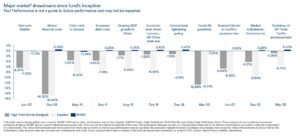
Advancing social impact and reputational advantages
Beyond the financial aspects, microfinance is intrinsically connected to advancing societal objectives. By extending credit, savings, and other financial services to individuals and small businesses underserved by the traditional banking sector, microfinance empowers entrepreneurship, supports local employment, and promotes sustainable economic development.
As the Swiss pension funds association ASIP[3] has reworked its ESG standards following calls from pension schemes for clearer frameworks, Swiss pension funds are increasingly guided by robust environmental, social, and governance (ESG) criteria. Typically classified under SFDR[4] highest requirements, microfinance provides a compelling option for impact-oriented investment solutions that align with responsible retirement savings and resonate with regulatory policies seeking sustainable investment options. This allows funds to demonstrate a measurable contribution to impact, moving beyond exclusion-based approaches, while fostering goodwill among stakeholders and testament to fiduciary responsibilities.
Key risks and due diligence considerations
It is important, however, to approach microfinance investments with thorough due diligence. Key risks include credit risk by end-borrowers and partner institutions, portfolio concentration and varying degrees of liquidity management. Governance standards, and regulatory oversight can also differ significantly across jurisdictions.
Pension funds must evaluate these factors carefully. Robust underwriting and risk management frameworks, on-the-ground presence across geographies, strong track record and transparent reporting on both financial and impact metrics are essential to ensure alignment with regulatory constraints and internal risk budgets.
Conclusion
As pension funds increasingly seek ways to deliver financial security and demonstrate a commitment to improved social outcomes, microfinance investments can play a meaningful role. The asset class offers a path to diversification for Swiss pension funds beyond traditional markets, alongside stable income streams that derive from a historically resilient sector operating in the real economy. When combined with demonstrable impact, the microfinance investment strategy presents an option that reflects the forward looking and sustainability-aware investment approach for which Swiss pension fund managers are increasingly known.
[1] Institutions for Occupational Retirement Provision Directive II (IORP II) and Pan-European Personal Pension Product (PEPP)
[2] BlueOrchard Microfinance Fund (BOMF) portfolio weighted average life of 1.8 years as of Jun-2025.
[3] ASIP, Schweizerischer Pensionskassenverband für eine starke berufliche Vorsorge.
[4] Sustainable Finance Disclosure Regulation (SFDR).
Important Information – BlueOrchard Microfinance Fund
Marketing material for Professional Clients and Qualified Investors only.
The information in this document was produced by BlueOrchard Finance Ltd (“BOF”), part of Schroders Capital which refers to those subsidiaries and affiliates of Schroders plc that together comprise the private markets investment division of Schroders. This information is not an offer, solicitation or recommendation to buy or sell any financial instrument or to adopt any investment strategy.
BlueOrchard Microfinance Fund (the “Fund”) qualifies as an Alternative Investment Fund (“AIF”) structured as a Société d’Investissement à Capital Variable (“SICAV”) and incorporated as a société anonyme (“S.A.”) under the laws of Luxembourg. This material must not be issued in any jurisdiction where prohibited by law and must not be used in any way that would be contrary to local law or regulation. Investors are responsible for ensuring compliance with any relevant local laws or regulations. Subscriptions may only be made on the basis of the Fund’s legal offering documents which can be obtained, free of charge, in English, from BlueOrchard Asset Management (Luxembourg) S.A., 5, rue Höhenhof, L-1736 Senningerberg, Luxembourg, on request. BlueOrchard Asset Management (Luxembourg) S.A. may decide to cease the distribution of any fund(s) in any EEA country at any time but will publish the intention to do so on www.blueorchard.com, in line with applicable regulatory requirements. The representative in Switzerland (“Swiss Representative”) is 1741 Fund Solutions AG, Burggraben 16, 9000 St. Gallen, and Bank Tellco AG, Bahnhofstrasse 4, 6430 Schwyz is the paying agent in Switzerland. The legal fund documents may be obtained free of charge, in English, from the Swiss Representative.
An investment in the Fund entails risks, which are further described in the Fund’s legal documents.
The Fund has the objective of sustainable investment within the meaning of Article 9 of Regulation (EU) 2019/2088 on Sustainability-related Disclosures in the Financial Services Sector (the “SFDR”). For information on sustainability-related aspects of this Fund please go to https://www.blueorchard.com/sustainability-disclosure-documents/. This product is not subject to UK sustainable investment labelling and disclosure requirements. The use of UN Sustainable Development Goals (SDG) icons or logo, including the colour wheel, is for purely informational purposes. The use of SDG icons and/or any reference to the SDGs is non-promotional and in no way is intended to imply any affiliation with or endorsement by the United Nations.
Past performance is not a guide to future performance and may not be repeated. The value of investments and the income from them may go down as well as up and investors may not get back the amounts originally invested. Exchange rate changes may cause the value of any overseas investments to rise or fall. Performance data does not take into account any commissions and costs, if any, charged when units or shares of any fund, as applicable, are issued and redeemed.
his material may contain “forward-looking” information, such as forecasts or projections. Please note that any such information is not a guarantee of any future performance and there is no assurance that any forecast or projection will be realised.
BOF has outsourced the provision of IT services (operation of data centres, data storage, etc.) to Schroders group companies in Switzerland and abroad. A sub-delegation to third parties including cloud-computing service providers is possible. The regulatory bodies and the audit company took notice of the outsourcing and the data protection and regulatory requirements are observed. For information on how BOF and the Schroders Group may process your personal data, please view the BOF Privacy Policy available at www.blueorchard.com/legal-documents/ and the Schroders’ Privacy Policy at https://www.schroders.com/en/global/individual/footer/privacy-statement/ or on request should you not have access to these webpages.
Issued by BlueOrchard Asset Management (Luxembourg) S.A., 5 rue Höhenhof, L-1736 Senningerberg, Luxembourg. Registration No B 170.191. Distributed in the UK by BlueOrchard Asset Management (Luxembourg) S.A., 5 rue Höhenhof, L-1736 Senningerberg, Luxembourg. Registration No B 170.191. Distributed in Spain by BlueOrchard Asset Management (Luxembourg) S.A., 5 rue Höhenhof, L-1736 Senningerberg, Luxembourg. Registration No B 170.191, a foreign management company, registered in the EEA investment firm register with the National Market Commission of Securities (CNMV) under registration number 248.